
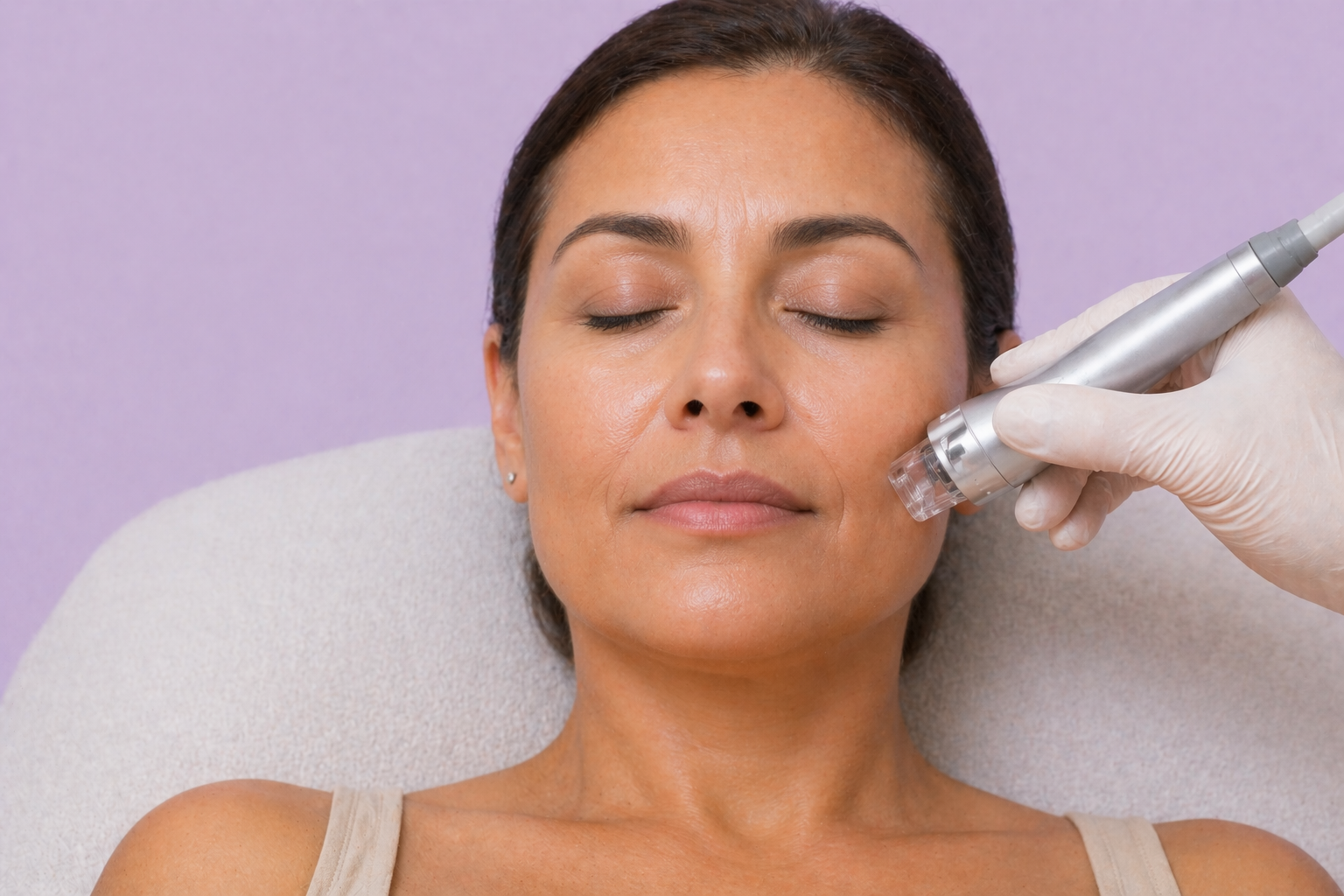
Fractional CO2 Laser
Looking younger doesn’t always have to involve surgery. Modern non-surgical techniques like laser treatments are now available, meeting the needs of patients with busy professional and personal lives who require effective results in just a few sessions with minimal downtime. This laser uses carbon dioxide gas to heat the dermis (the layer immediately below the epidermis), causing collagen to regain its lost shape, reducing wrinkles and rejuvenating the skin. This procedure is known as skin resurfacing. Fractional CO2 laser light heats damaged skin, improving it in just a few sessions. The fractional CO2 laser emits thousands of tiny beams that penetrate the skin as deep thermal columns, reaching the deep dermis. These thermal columns are areas of microscopic wounds separated by healthy surrounding tissue, which contains cells capable of promoting rapid healing. The energy that penetrates the deep dermis remodels the collagen. This procedure treats wrinkles, expression lines and facial sagging, and is also used to remove scars and even stretch marks in other areas of the body.
What are the advantages of skin rejuvenation with CO2 laser?
- It is currently the most effective method for rejuvenating your skin.
- A safe and reliable procedure that does not affect the surrounding tissue.
- Controlled and precise depth of penetration.
- Homogeneous skin regeneration.
- It can be performed under local anesthesia.
- It does not require admission, it is outpatient.
A novel laser treatment has emerged, the result of many years of research: Fractional CO2 Laser. The fractional CO2 laser exerts its effect on the water contained within the cells, heating the skin and inducing epidermal renewal and the reorganization of collagen and elastin fibers. Each of the small energy beams that give the laser its name, “fractional,” penetrates the skin, exerting its effect on columns of tissue that sometimes extend to the deep dermis and are called microthermal treatment zones.
Preparation for the procedure
- When the patient comes to the consultation, topical anesthesia is applied abundantly to all areas to be treated.
- The entire treatment lasts 20 to 30 minutes. Side effects are minimal; swelling may last for a day and redness for 4 to 5 days.
- The skin takes on a tanned tone for several days, allowing you to immediately return to your usual activities.
- Fractional laser treatment does not require infiltration anesthesia; topical anesthesia is sufficient.
- Improvement with fractional laser treatment is observed after the first 5 days when the micro-scabs that have formed at the laser’s treatment sites begin to leave behind healthier, smoother, and more beautiful skin.
- The inflammation produced by the laser in the skin causes it to continue improving even after the skin has fallen off or micro-scabs have formed, and for a period of up to 3 months.